March 8, 2026
What Is a Meta Agency Ad Account? How It Works vs a Regular Account
A Meta agency ad account is an advertising account setup used through an agency structure, often with onboarding help, access guidance, billing support, and operational assistance. This article explains how it works, how it compares with a regular Meta ad account, and who should use it.
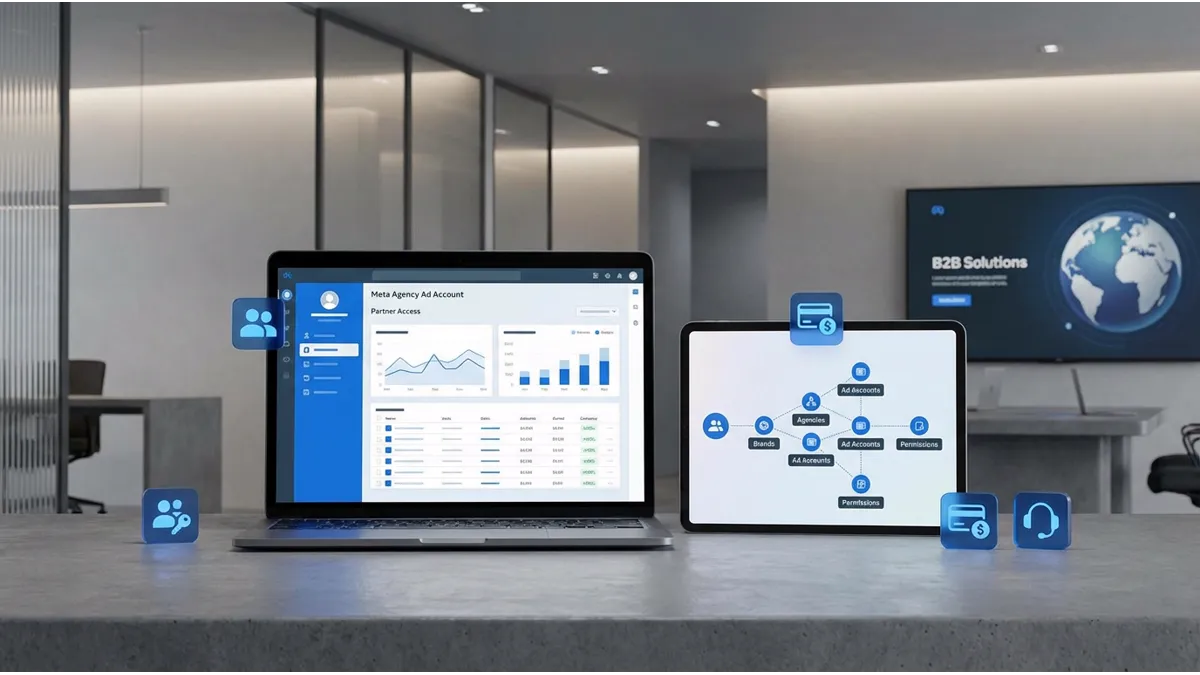
A meta agency ad account is usually an advertising account made available through an agency structure rather than created only inside your own self-serve setup. In practice, businesses use it to get account access, structured onboarding, billing guidance, and day-to-day operational support while still running campaigns in Meta’s ad ecosystem. Meta’s official tools center on Meta Business Suite, business portfolios, ad accounts, and partner access.
- Typical setup
- Meta agency ad account: Access provided through an agency structure
- Regular Meta ad account: Created directly by your business
- Main goal
- Meta agency ad account: Operational support, access help, workflow structure
- Regular Meta ad account: Full self-serve control
- Permissions
- Meta agency ad account: Usually shared through partner access and role setup
- Regular Meta ad account: Managed directly inside your business setup
- Billing
- Meta agency ad account: May involve cards, top-ups, invoicing, or provider guidance
- Regular Meta ad account: Usually your own direct payment method
- Best fit
- Meta agency ad account: Brands, agencies, and media buyers scaling seriously
- Regular Meta ad account: Smaller teams or early-stage advertisers
- Trade-off
- Meta agency ad account: Less direct ownership in some models
- Regular Meta ad account: Less support and less external infrastructure
What is a Meta agency ad account?

What advertisers usually mean by “Meta agency ad account”
When people say meta ad agency account or facebook agency ad account, they are usually not talking about a special button inside Meta called “agency account.” They are talking about an ad account that is accessed through an agency relationship, often with more structure around permissions, billing, support, and onboarding.
In other words, the phrase is practical industry language. It describes how the account is provided and operated, not just where campaigns are launched. Therefore, a meta ad account for agencies is less about magic settings and more about the business relationship behind the account.
How it fits into the Meta Business ecosystem
Meta’s official ecosystem is built around Meta Business Suite, business portfolios, ad accounts, people, and partners. A business portfolio can hold assets such as Pages, Instagram accounts, and ad accounts. It can also share or assign assets to people and partners. Likewise, businesses can create a new ad account, claim an existing one, or request shared access to one.
That is why a meta agency account usually sits inside a broader permissions and asset structure. The agency may provide the ad account, the client may connect its Page and pixel, and both sides may work through partner access rather than a loose login-sharing setup.
Why the term is popular among agencies, media buyers, and ecommerce brands
The term is popular because it answers a real operational need. Agencies want cleaner client workflows. Media buyers want access without messy ownership confusion. Ecommerce brands want to launch faster without building every piece from scratch. As a result, the phrase agency ad account meta keeps showing up in the market even though the official Meta documentation speaks in terms of ad accounts, business portfolios, and partners.
How does a Meta agency ad account work?
How agency access is typically structured
A meta agency advertising account usually works through shared business access. The provider or agency controls the main account structure, then grants the advertiser the permissions needed to run campaigns. That can mean account-level access, asset-level access, or partner access through the business portfolio.
This matters because a strong structure reduces confusion from day one. Instead of passing passwords around, the business can work through official permissions, assigned people, and linked assets.
How partners, permissions, and business assets are managed
Meta allows businesses to add partners to a business portfolio and assign business assets to them. It also allows businesses to add people and define permissions for those people and assets. Accordingly, a meta ad account for agencies often depends on three moving parts: who owns the business portfolio, who owns the ad account, and which assets the client connects to it.
For example, a brand may keep ownership of its Facebook Page, Instagram account, catalog, and pixel, while the agency meta ad account is used for campaign delivery. That can be a sensible structure because the brand keeps core assets while the agency handles infrastructure and support.
What role the agency plays after onboarding
After onboarding, the agency’s role is usually operational, not always strategic. Some providers mainly help with account access, permissions, billing workflows, troubleshooting, and continuity. Others also provide campaign help. Therefore, businesses should always ask where support stops.
ShopyAds positions itself as an infrastructure and support partner rather than a campaign management agency. Its site emphasizes stability-focused agency ad accounts, structured onboarding, access guidance, and operational help across Meta, Google Ads, TikTok, and Snapchat.
How billing, top-ups, or invoicing may work depending on the setup
Billing is one of the biggest differences between a regular account and a facebook ad agency account model. On standard Meta accounts, advertisers generally add their own payment method, and Meta supports options such as credit or debit cards, PayPal, bank account direct debit in supported markets, and available funds.
In an agency setup, however, billing can vary. Sometimes the advertiser funds the account directly. In other cases, the agency manages top-ups, invoicing, or funding guidance. That is why billing clarity should be discussed before launch, not after spend starts.
Meta agency ad account vs regular account

Ownership and control
This is the first question serious advertisers should ask. A regular Meta account is usually created and owned directly inside your business setup. By contrast, a meta agency ad account vs regular account comparison often reveals that the agency model may involve shared control or provider ownership of the ad account itself.
That does not automatically make it worse. It simply changes the risk profile. If your business values maximum in-house ownership above all else, a regular account may feel safer. On the other hand, if your priority is workflow support and infrastructure, a managed meta ad account may be more attractive.
Access, permissions, and team management
A regular account is fine when a small internal team can manage everything. However, a meta partner ad account model often becomes attractive when multiple buyers, freelancers, brand managers, and client stakeholders need structured access.
The main advantage here is not glamour. It is cleanliness. Clear roles reduce accidental changes, protect assets, and make onboarding new team members easier. Meta’s business tools are built around that logic.
Account stability and operational support
This is where many businesses become interested in a whitelisted meta ad account or other agency-led setup. Still, this part is often oversold online. A good provider can improve structure, guidance, and responsiveness. It cannot honestly promise permanent safety or guaranteed approvals.
A stronger way to think about it is this: a meta agency account may give you better operational support when issues happen. That includes help with permissions, billing, structure, communication, and next steps. It does not erase Meta policy enforcement.
Scaling potential and spend flexibility
Many provider pages make extreme claims here. A better answer is more practical. A meta agency ad account for ecommerce can help teams that need faster setup, cleaner account workflows, and more scalable operations. Yet campaign success still depends on offer quality, creative, targeting, landing page strength, and policy compliance.
So yes, a meta agency ad account for brands may feel more scale-ready. However, the value usually comes from infrastructure and support, not from a magical performance switch.
What trade-offs businesses should understand before choosing
Before choosing a facebook agency ad account, understand the trade-offs clearly:
- You may not directly own the ad account itself
- Billing may follow the provider’s workflow
- Access can be cleaner, but also more dependent on the provider
- Support can be stronger, but only if the provider is credible
- Your best setup depends on team size, budget, and growth stage
In short, a regular account gives more direct control. A meta ad account for agencies often gives more operational help.
Why do businesses use a Meta agency ad account?
For scaling paid campaigns faster
Scaling teams care about speed. They do not want a loose setup that slows launches, blocks approvals internally, or creates confusion around who can touch which asset. Therefore, a meta agency ad account is often attractive to teams that already know how to buy media and simply want cleaner infrastructure.
For more structured support
Many brands do not need someone else to write their ads. They need someone to help them with access, setup, permissions, payment flow, and issue handling. That is why a meta ad agency account is often more attractive than full outsourced campaign management.
For agencies managing multiple clients
Client work becomes messy very quickly without structure. An agency ad account for facebook ads can help an agency keep account access organized, reduce role confusion, and manage operations across several client environments.
For brands that want operational help without giving up campaign execution
This is one of the strongest use cases. A brand can keep control over creative direction, offer testing, reporting, and buying decisions while using a meta agency advertising account for support and access structure. In addition, this model can reduce the burden on the internal team.
Who should use a Meta agency ad account?
Ecommerce brands
A meta agency ad account for ecommerce makes the most sense when the brand is already spending consistently, running creative tests, and needs dependable workflows around assets and permissions.
Media buyers and performance teams
A meta agency account for media buyers is useful when the buyer needs a cleaner operating environment, especially if several stakeholders are involved.
Marketing agencies
A meta ad account for agencies is a natural fit for agencies handling multiple brands, multiple buyers, and multiple approval flows.
Businesses expanding across markets or verticals
As teams grow, operational complexity grows with them. Accordingly, a facebook ad agency account may become more valuable once expansion creates more users, more assets, and more moving parts.
When is a regular Meta ad account enough?
Small budgets and early-stage testing
A regular account is often enough for small businesses testing offers, audiences, and creative for the first time. If you are still proving product-market fit, you may not need a managed meta ad account yet.
Teams that want full in-house control
Some businesses simply want everything under their own roof. That is reasonable. If your team can manage setup, permissions, billing, and troubleshooting internally, a regular account can be the right answer.
Cases where a business does not need agency infrastructure yet
Not every advertiser needs a meta agency ad account immediately. Sometimes the best move is to start simple, build internal discipline, and move to agency infrastructure only when workflow pain becomes real.
What to check before getting a Meta agency ad account

Who owns the ad account
Ask this directly. Do not assume. A serious provider should tell you whether the ad account is provider-owned, shared, or client-owned.
What access you receive
Ask what permissions you actually get. Can your media buyer launch campaigns? Can your analyst read performance? Can your team add people later? In other words, define the real working model of the agency meta ad account.
How billing is handled
Ask whether you fund the account directly, top up through the provider, or receive invoices. In addition, ask what happens if a payment issue appears.
What support is included
Support is one of the main reasons to choose a meta ad agency account. So ask exactly what is included: onboarding help, roles guidance, billing questions, troubleshooting, or continuity support.
What happens if an account issue appears
This question matters more than sales language. Ask what process exists if there is a restriction, payment issue, or asset access problem. ShopyAds states that it provides operational support for access issues, billing questions, structure optimization, and workflow guidance, while also noting that outcomes still depend on platform policies.
What assets remain under your control
As a rule, your business should protect the assets that define your long-term value. That may include your Page, Instagram account, pixel, catalog, domain, and creative files. A solid meta agency ad account for brands should work with those assets, not blur who owns them.
How onboarding usually works with a Meta agency ad account
Business review and qualification
Most providers begin with a review of business type, monthly spend, and platform fit. ShopyAds says applicants submit platform preference and business details, then the team reviews eligibility and requirements, usually within 24 to 48 hours.
Access setup and permissions
After qualification, the next step is access structure. This usually includes role assignment, partner access, and guidance on how the business should connect assets and users.
Payment or billing configuration
Then comes billing. Depending on the setup, this may include payment method configuration, funding instructions, or invoicing guidance.
Launch and ongoing support
After setup, campaigns launch and the ongoing value becomes operational support. ShopyAds says it provides support via WhatsApp and email, with typical responses within 24 hours on business days for many support questions.
Meta agency ad account for agencies managing clients
Why agencies use this model
Agencies use this model because client operations are rarely simple. A facebook agency ad account can help agencies build repeatable workflows instead of reinventing access, billing, and permissions for every client.
How it helps with multiple brands or accounts
When an agency handles several brands, a meta ad account for agencies can make access cleaner and more systematic. That matters for onboarding, approvals, reporting, and handoffs between account managers and media buyers.
Best practices for agencies working with client assets
Agencies should keep client assets documented, respect permission boundaries, and avoid mixing brand ownership with campaign access. In addition, they should define who owns the ad account, who owns the pixel, and who can remove or add users.
How Meta agency ad accounts compare with other agency ad account types

Meta agency ad account vs Google Ads agency account
Google Ads has an official manager account model. Google says a manager account lets you manage multiple Google Ads accounts from one dashboard, and it highlights access control and consolidated management. Google also notes that a manager account is required for accounts using monthly invoicing.
So the Google model is more explicitly formalized in product language than the everyday market phrase meta agency ad account.
Meta agency ad account vs TikTok agency ad account
TikTok’s equivalent structure centers on Business Center. TikTok says Business Center is a central place to manage business and advertising activities, permissions, and assets. It also allows verified businesses to create ad accounts, request access, and transfer ownership inside Business Center.
That means a TikTok agency model is also built around organized access and asset control, much like a meta partner ad account workflow.
Meta agency ad account vs Snapchat agency ad account
Snapchat’s self-serve system runs through Snapchat Ads Manager, and Snapchat positions it as a platform with flexible budgets and campaign control. Snapchat also runs an Agency Partner Program for agencies that want official partnership benefits and support.
So, compared with Snapchat, a meta agency advertising account is part of a broader multi-platform conversation about structure, not just spend.
Why multi-platform advertisers care about account infrastructure
Once a brand runs Meta, Google Ads, TikTok, and Snapchat together, account infrastructure starts to matter almost as much as media buying. Clean permissions, billing clarity, asset control, and operational support help teams move faster across channels. That is also how ShopyAds presents its offer: multi-platform readiness with onboarding and operational support, not just account access.
Conclusion: is a Meta agency ad account the right choice for your business?
Quick summary for brands
A meta agency ad account can be the right choice if your brand already knows how to run campaigns and now needs cleaner structure, better support, and less operational friction.
Quick summary for agencies and media buyers
For agencies and performance teams, a meta ad account for agencies is often valuable because it helps organize client work, access levels, and account operations more professionally.
What to do next before choosing a provider
Before choosing any provider, ask about ownership, permissions, billing, support, and asset control. That single checklist will tell you far more than hype about “instant approvals” or “no bans.” A good facebook ad agency account setup should feel clear, accountable, and workable from day one.
Frequently Asked Questions
What is a meta agency account?
A meta agency account usually means an ad account or account structure provided through an agency relationship, with support around access, permissions, billing, and onboarding.
How does a Meta agency ad account work?
It usually works by giving the advertiser shared access through Meta’s business tools, while the agency or provider helps manage setup, permissions, and operational workflows.
What is the difference between a Meta agency ad account and a regular account?
A regular account is usually created and controlled directly by your business. A meta agency ad account often adds external infrastructure and support, but sometimes with less direct ownership of the ad account itself.
What is the 20 rule for meta ads?
Today, there is no general Meta rule that limits image ads to 20% text. Meta’s own image ad guidance says there is no longer a limit on the amount of text in an ad image, and the text overlay tool was removed starting in March 2026. Still, lighter, clearer creative is often better for readability.
Is $10 a day enough for Facebook ads?
It can be enough for early testing, especially for narrow audiences or simple traffic campaigns. However, it is usually not enough for fast learning across many audiences, creatives, and objectives.
What is the 3-3-3 rule in marketing?
This is a common marketing framework, not a Meta rule. It usually means focusing on three key messages, three audience segments, and three main channels or touchpoints.
Is $5 a day enough for Facebook ads?
It can work for very small tests, local offers, or message validation. Even so, results may come slowly, and optimization options will be limited.
What are the 7 main types of advertising?
There is no single universal official list. A common breakdown includes social media advertising, search or PPC advertising, display advertising, video advertising, mobile advertising, print advertising, and out-of-home advertising.
What is an example of an ad agency?
An ad agency can be a paid media team that helps brands plan campaigns, manage creative workflows, buy media, and report results across channels such as Meta, Google Ads, TikTok, and Snapchat.
What are the 7 tactics of marketing?
People often use this question to mean the 7 Ps of marketing: product, price, place, promotion, people, process, and physical evidence. That is a classic framework for planning and evaluating marketing strategy.